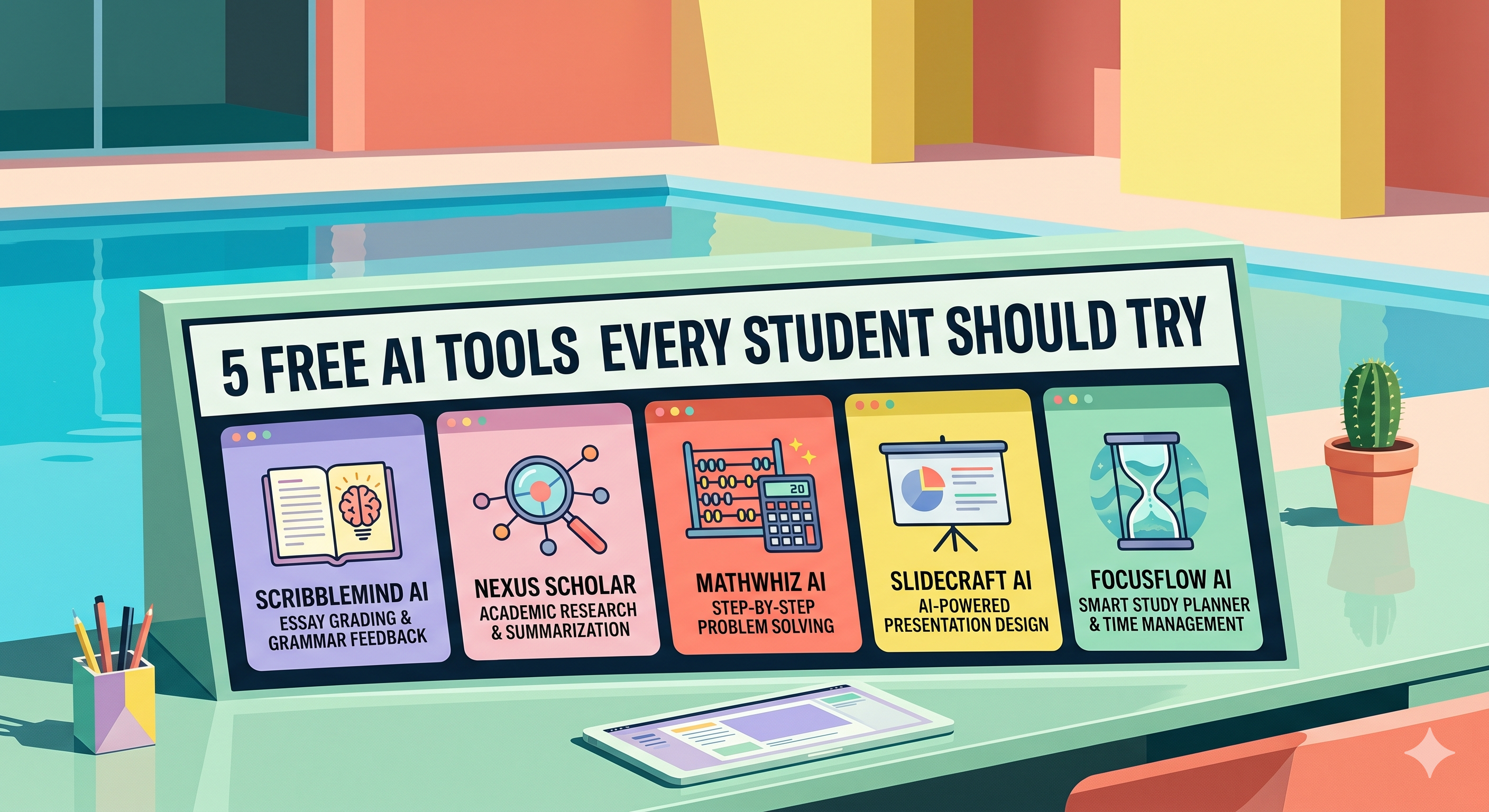
5 Free AI Tools Every Student Should Try
The conversation around AI in education often circles a single, unhelpful topic: cheating. But that conversation misses the point. Used correctly, AI is one of the most powerful learning aids to come along in decades. It can help you research more efficiently, write more clearly, and study more effectively.
Forget about asking an AI to write your essay for you. The real value is in using these tools as a tireless study partner—one that can help you synthesize information, polish your prose, and test your knowledge. Here are five categories of free AI tools that every student should explore.
1. AI-Powered Search Engines for Better Research
Standard search engines are great, but they give you a list of links, not answers. AI-powered search engines, or "answer engines," are different. They synthesize information from multiple sources to give you a direct answer to your questions, complete with citations.
For students, this is a research superpower. Instead of clicking through dozens of tabs, you can get a concise summary of a topic, helping you grasp the basics before you dive deeper. Because these tools provide their sources, you can easily check the information and explore the original articles for more detail. This approach helps you build a foundational understanding of a topic quickly and efficiently.
Best For: • Getting a quick overview of a new topic. • Finding direct answers with sources for specific questions. • Building a preliminary bibliography for a research paper.
2. AI Writing Assistants for Clearer Communication
Your ideas matter, but if they're buried under clunky sentences or grammatical errors, they won't get the credit they deserve. AI writing assistants are designed to help you communicate more clearly by acting as a real-time proofreader and style coach.
These tools go beyond the basic spell check built into your word processor. They can help you spot passive voice, identify confusing sentence structures, and even suggest ways to make your writing more concise. Using an AI writing assistant isn't about having an AI write for you—it's about refining what you have already written. It’s a tool for improvement, not generation.
A Word of Caution: Always review the suggestions. AI doesn't always understand the nuance of your argument, and it can sometimes make "correct" suggestions that change your meaning. Use it as a guide, not a dictator.
3. AI Summarizers for Efficient Reading
The academic world is filled with dense journal articles, long book chapters, and extensive reading lists. An AI summarizer can help you manage the load by condensing long texts into a few key bullet points. This is not a replacement for careful reading, but a way to triage your assignments.
By pasting in text or providing a link, you can get a high-level overview of an article's argument in seconds. This allows you to quickly assess whether a source is relevant to your research before you commit to a full read-through. It's also an excellent way to review material you've already read, helping you recall the main points without rereading the entire document.
How to Use It Smartly: • Generate summaries of potential research articles to see if they are relevant. • Review the key points of a chapter you read last week. • Break down a complex topic into a more digestible format.
4. AI Flashcard and Quiz Generators for Active Recall
Passive studying—like rereading your notes or highlighting a textbook—is one of the least effective ways to learn. Active recall, where you force your brain to retrieve information, is far more powerful. AI can make this process dynamic and engaging.
Tools are now available that can take your notes, a PDF, or even a YouTube video and automatically generate flashcards and practice quizzes. This saves you the tedious work of creating study materials yourself and allows you to spend more time actually learning. With a constant stream of new questions, you can test your knowledge from different angles and solidify your understanding.
5. AI Tutors and Learning Platforms
Companies at the forefront of educational technology are now integrating AI tutors into their platforms. These aren't just glorified chatbots; they are sophisticated programs designed to guide you through problems, explain complex concepts, and adapt to your learning pace.
Platforms like Khan Academy have introduced AI-powered features that act as a Socratic guide, asking questions to help you arrive at the answer yourself instead of simply providing it. While many of these features are still new, they represent the future of personalized learning. They offer a level of one-on-one interaction that was previously unavailable to most students.
A Note on Limitations and Ethics
AI tools are incredibly useful, but they are not infallible. They can make mistakes, present biased information, or completely invent facts—a phenomenon known as "hallucination." Always be a critical user. If an AI gives you a piece of information, especially for a research project, verify it with a trusted source.
Equally important is understanding your school's academic integrity policy. Most universities have clear rules about how and when you can use AI tools. The key is transparency and honesty. Using AI to brainstorm, research, or proofread is generally acceptable. Using it to write your work is plagiarism. When in doubt, ask your professor.
Conclusion: Your New Study Partner
AI isn’t a shortcut to a degree; it’s a tool that can help you earn one more effectively. By embracing AI for research, writing feedback, and active studying, you can deepen your understanding and produce better work.
Forget the hype and the fear. The smart student isn’t the one who avoids AI, but the one who learns to use it wisely and ethically. So go ahead and give these tools a try—your brain will thank you.