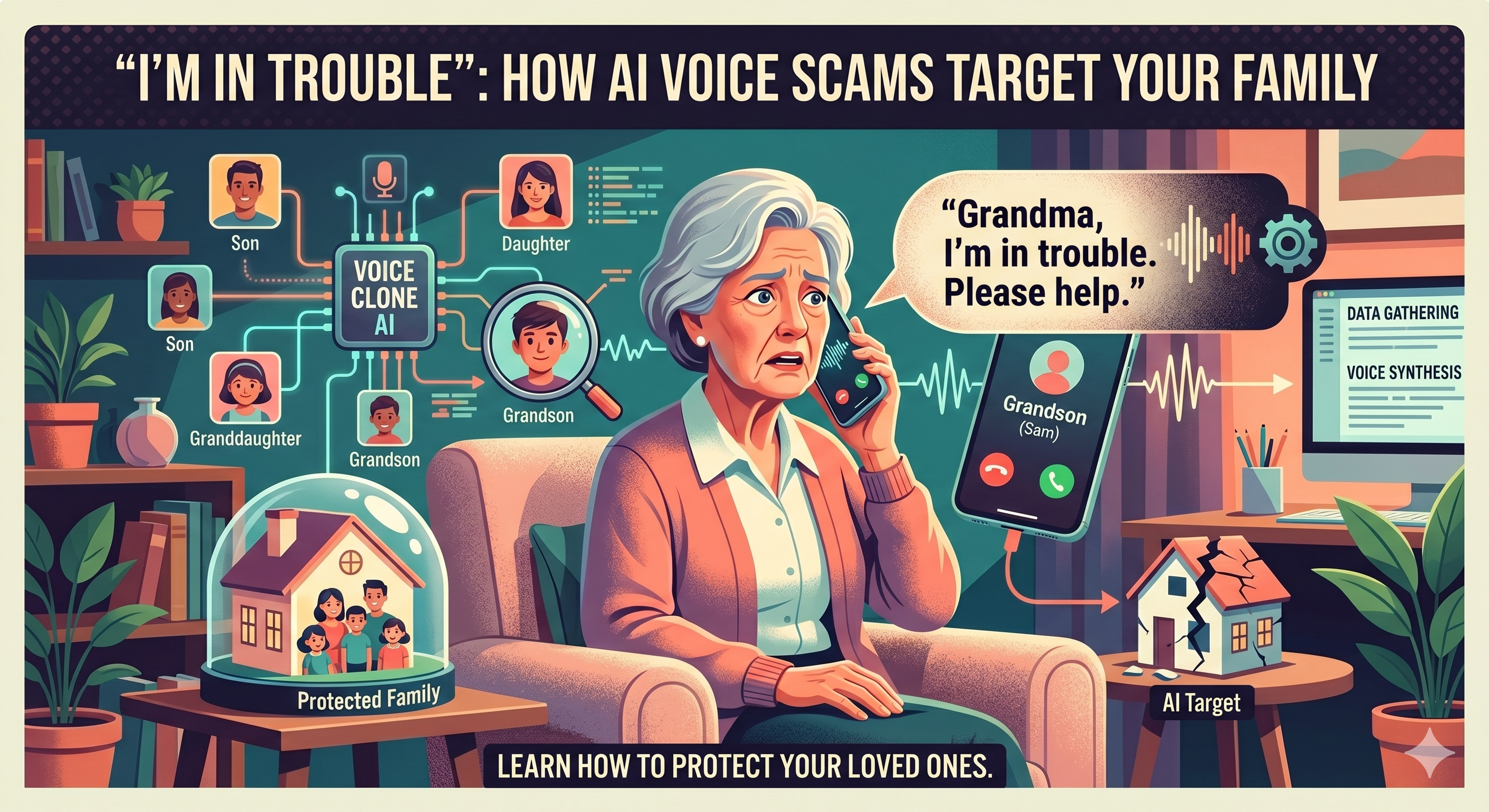
“I’m in Trouble”: How AI Voice Scams Target Your Family
It’s a phone call no one wants to receive. A loved one is in trouble — a car accident, a legal problem, a medical emergency — and they need money, fast. The voice on the other end is familiar, filled with panic, and it sounds exactly like your child, grandchild, or sibling. But it isn’t. You’re the target of a sophisticated new wave of scams powered by artificial intelligence.
This isn’t science fiction. It’s an evolution of a classic trick known as the “grandparent scam,” now supercharged with voice-cloning technology. These deepfake scams are on the rise, and they prey on our deepest instincts: the desire to protect our family. Understanding how these scams work is the first step toward not falling for them.
The Three-Second Snatch
What’s most unsettling about voice-cloning technology is how little data it needs. Scammers can create a convincing replica of a person’s voice with as little as a three-second audio clip. Where do they get this audio? From the vast trail of digital breadcrumbs we leave online.
Social media is a primary source. That Instagram story you posted, the TikTok video your niece was in, a public Facebook reel — any instance where a voice can be isolated is a potential goldmine for a scammer. Voicemail greetings are another easy target. Once they have a sample, AI software can analyze the unique qualities of the voice — its pitch, tone, and cadence — to generate new words and sentences that sound just like the real person.
Anatomy of a Deceptive Call
The goal of a voice-cloning scam is to create a high-pressure situation that forces you to act before you can think. The call often begins with a frantic-sounding loved one quickly explaining their dire circumstances. They might say they’re in jail, in the hospital, or stranded in another country.
To make the story more believable, the scammer might hand the phone to an accomplice posing as an authority figure — a lawyer, a doctor, or a police officer — who backs up the story and provides instructions for sending money. The payment method is almost always urgent and difficult to trace, like a wire transfer, cryptocurrency, or gift cards. The key is to keep you on the phone and in a state of alarm, preventing you from hanging up and verifying the story.
More Than Just Grandparents
While these scams initially earned the “grandparent scam” nickname because they frequently targeted older adults, anyone can be a potential victim or a target for voice cloning. Scammers are equal-opportunity predators. They might call a parent with a cloned voice of their child, or even target a person by faking the voice of their spouse or best friend.
The emotional connection is the weapon. If you believe a loved one is in danger, your rational mind takes a backseat. Scammers know this and exploit that bond without mercy.
How to Protect Your Family
Fighting back against deepfake scams doesn’t require technical expertise. It requires skepticism, verification, and a pre-planned strategy. Here are the most effective ways to protect yourself and your loved ones:
• Create a Family Safe Word. This is the single most powerful tool against a voice scam. Choose a unique word or phrase that only your immediate family knows. It should be something a scammer couldn’t guess from social media, like an inside joke or the name of a childhood pet you never posted about. If a caller claims to be a family member in an emergency, ask them for the safe word. If they can’t provide it, hang up.
• Don’t Trust Caller ID. Scammers can easily “spoof” phone numbers to make a call appear to be coming from a legitimate source, even from the contact number of the person they are impersonating. Just because the screen shows “Mom” or “David” doesn’t mean it’s them.
• Hang Up and Call Back. If you receive a distressing call, the best course of action is to hang up. Then, call your loved one back on their known phone number. If they don’t answer, try another family member or friend to verify the story. A real emergency will still be an emergency in five minutes.
• Be Wary of Social Media Privacy. Consider making your social media accounts private. Be mindful of the audio and video content you or your family members share publicly. The less audio a scammer has, the harder it is to create a convincing clone.
If You Get Scammed
If the worst happens and you lose money to a scam, act quickly. Call your bank or credit card company to report the fraud and see if the transaction can be stopped. Report the scam to the Federal Trade Commission (FTC) and your local police department. While recovery is difficult, reporting the crime helps authorities track these operations and warn others.
The New Reality
AI is not going away. As the technology becomes more accessible, we’ll see more of these deceptive tactics. This new reality calls for a new kind of digital literacy — one where we learn to question what we see and hear, even when it comes from a seemingly trusted source.
Protecting ourselves and our families starts with awareness. Have a conversation about voice-cloning scams with your loved ones, set up a safe word, and agree to always verify before acting. In an age of convincing fakes, a healthy dose of skepticism is our best defense.