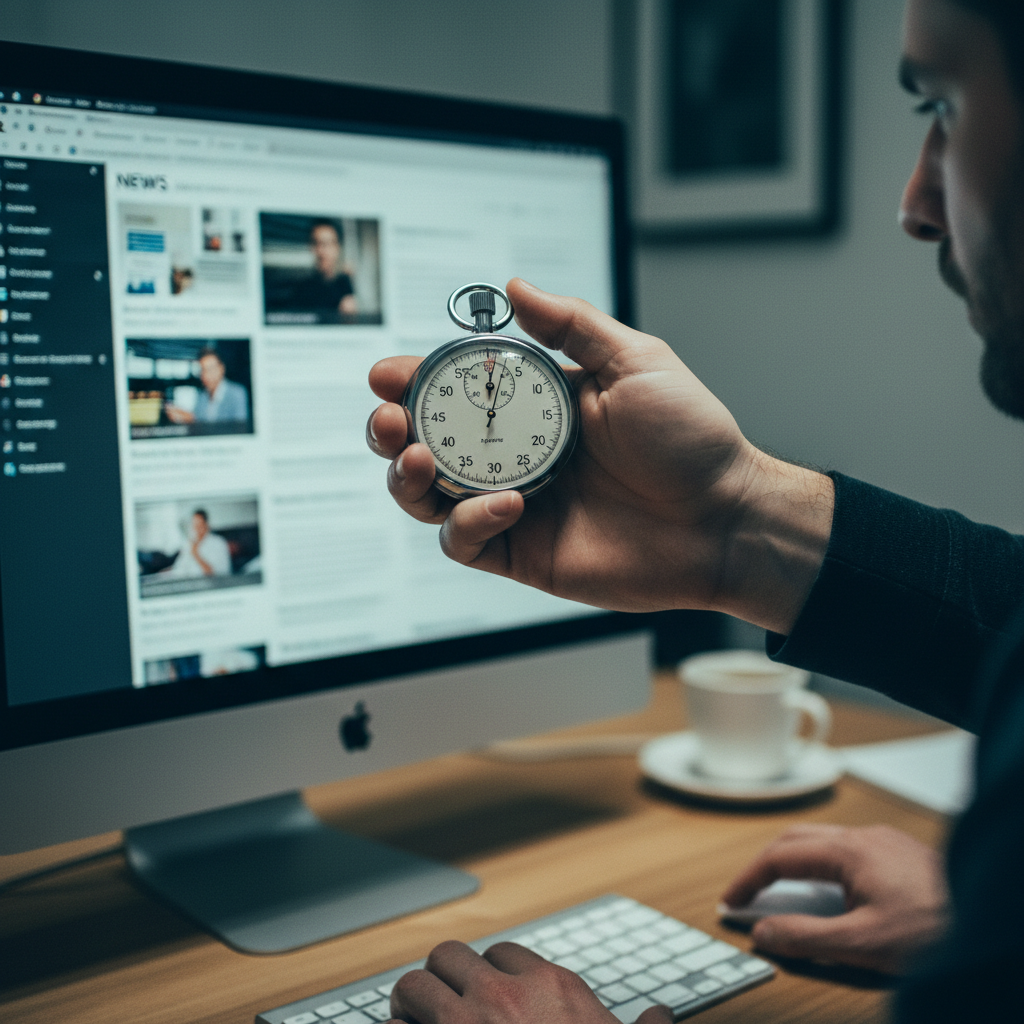
How to Fact-Check a Viral Claim in Under 60 Seconds
You’re scrolling through your social media feed when you see it: a shocking headline, an unbelievable photo, or a "secret" cure. Your thumb hovers over the share button. It’s compelling, and you feel the urge to pass it on. But is it true?
In our hyper-connected world, misinformation spreads faster than ever. It preys on our emotions, biases, and the speed at which we consume content. But what if you could build a defense against it—a rapid-response system for spotting falsehoods? You can. You don’t need a journalism degree, just a few simple habits that take less than a minute.
Your 60-Second Toolkit
Let's be clear: a 60-second fact-check isn’t a deep, comprehensive investigation. It’s a first pass. It's an essential tool for deciding if a piece of information is worth your attention or a share. Think of it as a mental filter that catches the most obvious junk before it clutters your mind—and your feed.
Performing these quick checks helps build a crucial habit. The more you do it, the more automatic it becomes. Soon, you'll find yourself instinctively questioning sources and verifying information without even thinking about it. You become a more critical consumer of information, which is a superpower in the digital age.
Technique 1: Read Laterally
When we encounter an article, our instinct is to read it "vertically"—staying on the page, reading from top to bottom, and judging its credibility based on its internal cues. The problem is that a well-designed piece of misinformation is built to look credible. It wants you to stay put and believe its claims.
Instead, professional fact-checkers use a technique called "lateral reading." As soon as you land on an unfamiliar site, you should:
• Open a new tab. • Search for the name of the publication, organization, or author. • See what other, trusted sources say about them.
This simple action is often all you need. A quick search can reveal in seconds if a source is a known satire website, a biased political blog, a state-sponsored propaganda outlet, or a respected news organization. You’re no longer relying on the source to vouch for itself; you’re using the rest of the internet to get the real story.
Technique 2: Master the Reverse Image Search
Misinformation often relies on powerful visuals to trigger an emotional response. A photo of a purported war crime, a graph "proving" a conspiracy, or a heartwarming picture of a supposed hero can all be used to deceive.
Viral content frequently uses old images out of context. The good news is that you can check an image's origin in seconds with a reverse image search.
• On a desktop, right-click an image and select "Search image with Google" (or a similar option on other search engines like TinEye). • On a mobile device, long-press the image and you should see a similar option pop up.
The search results will show you where else the image has appeared online and, often, when it was first uploaded. This can instantly debunk a post. You might find that a photo of a protest from a decade ago is being passed off as a current event, or that a "leaked" image is actually a frame from a movie.
Technique 3: Interrogate the Source
Let's say a source isn’t immediately identifiable as a fake. It’s time for a slightly deeper, yet still very quick, look. Reputable information sources are generally transparent. Disinformation sources thrive on ambiguity.
Ask yourself these questions:
• Is there an "About Us" page? Legitimate organizations are proud to tell you who they are, who funds them, and what their mission is. If this information is missing or vague, it's a major red flag. • Is there a corrections policy? Trustworthy journalism involves accountability. Outlets that are serious about the truth will have a clear and visible policy for correcting their mistakes. • What else do they publish? Take a quick scan of their other headlines. If a site publishes one serious-looking news story surrounded by celebrity gossip, miracle health cures, and alien conspiracy theories, you should be skeptical of everything on it.
Technique 4: Use an AI Fact-Checking Assistant
In the fight against bad information, AI can be a powerful ally. While you can do all this manual work yourself, modern AI tools can dramatically speed up the process, doing the heavy lifting for you.
Here at Truth Seeker AI, our tools are built to act as your fact-checking co-pilot. You can provide a link, a headline, or a chunk of text, and our AI can help:
• Summarize long articles to get the main points without you having to read the whole thing. • Analyze the core claims being made. • Cross-reference those claims against databases of trusted, independent fact-checks and reports from major news organizations.
Think of it as an assistant that performs the lateral reading for you at lightning speed. It provides a quick summary of the public consensus on a topic, telling you if a claim is widely verified, actively disputed, or already debunked by reputable sources.
Your 60-Second Workflow in Action
Let’s see how this works. You see a viral tweet: "SHOCKING STUDY: Scientists at the Institute for Cognitive Health say eating three bananas a day reverses memory loss!"
• Seconds 1-20 (Read Laterally): You open a new tab and search for the "Institute for Cognitive Health." Your search reveals it doesn’t exist. Instead, you find articles from medical experts debunking similar claims about bananas and memory. Red flag. • Seconds 21-35 (Interrogate the Source): You look at the Twitter account that posted it. The bio is full of buzzwords like "truth teller" and "health freedom," and its feed is a mix of other dubious health claims. Red flag. • Seconds 36-60 (Use an AI Assistant): For good measure, you paste the claim into an AI fact-checker. It instantly reports that no major medical or scientific body supports this claim and links to several articles from health authorities explaining that while bananas are healthy, they are not a cure for memory loss.
Conclusion: Check Before You Share
In less than a minute, you’ve confidently determined this viral claim is nonsense. You haven't fallen for it, and more importantly, you haven't shared it. The goal isn’t to become cynical about all information but to become a more discerning and responsible digital citizen.
By building these simple habits—reading laterally, doing a quick reverse image search, checking the source, and using modern tools—you strengthen your own media literacy and help foster a healthier information environment for everyone. All it takes is 60 seconds.